Firebreaks and Bushfire Prevention
All landowners and occupiers must complete bushfire prevention works in accordance with the current Bushfire Risk Compliance Notice (the Notice), issued under section 33 of the Bush Fires Act 1954.
Required works must be completed before 3 November and maintained until 30 April each year, unless otherwise stated in the Notice. Property owners and occupiers should check the requirements for their zoning and complete works early where possible.
If the standard requirements are not practical for your property, you may apply for a variation before 31 October. Approved variations must be in place by 3 November and maintained for the full compliance period.
CHECK YOUR BUSHFIRE PREVENTION REQUIREMENTS - Download the current Bushfire Risk Compliance Notice
CAN'T MEET THE STANDARD REQUIREMENTS? - Apply for a Bushfire Risk Compliance Notice Variation before 31 October
Firebreaks and driveways
Firebreaks and driveways mean a trafficable area or strips of land cleared of flammable materials, such as grass, leaf litter, and fallen tree debris and waste. Effective installation and maintenance combined with reduced fuel load help slow the spread and intensity of bushfires while providing safe and reliable access for maintenance, firefighting, and emergency service vehicles.
Ensuring your property and firebreaks are properly prepared and maintained before the bushfire season plays a crucial role in safeguarding your property, neighbouring properties, businesses, infrastructure, livestock, and the wider community. Planning ahead, including spraying or clearing vegetation before peak growth periods, can make ongoing maintenance easier and help reduce the time and cost required to meet firebreak requirements.
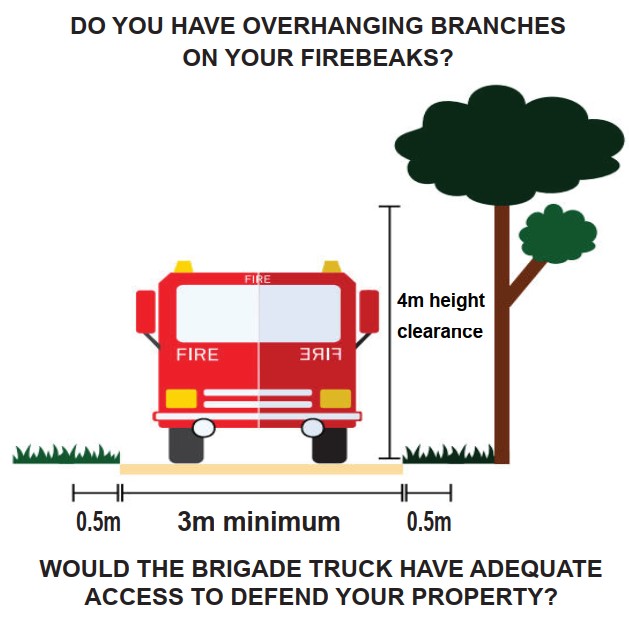
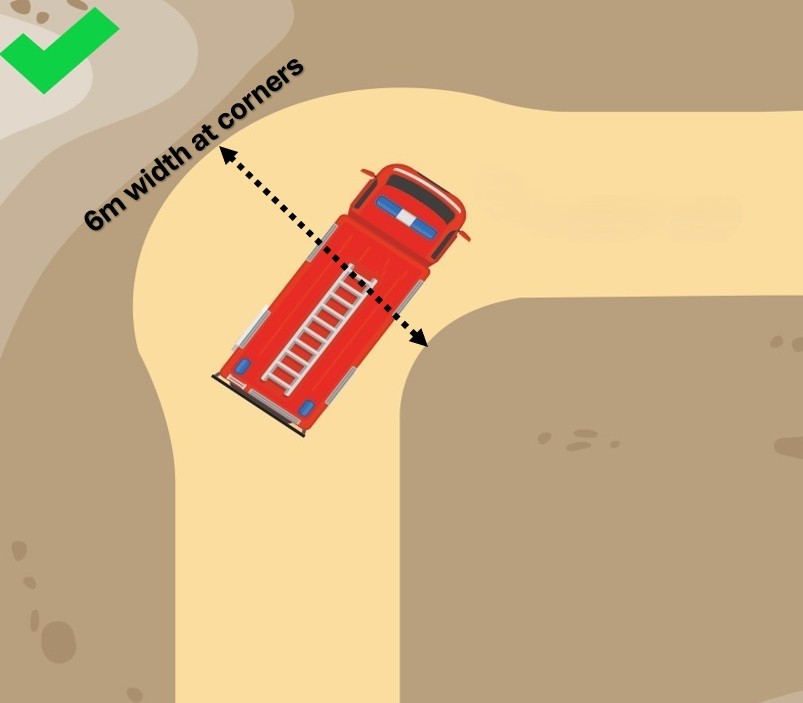
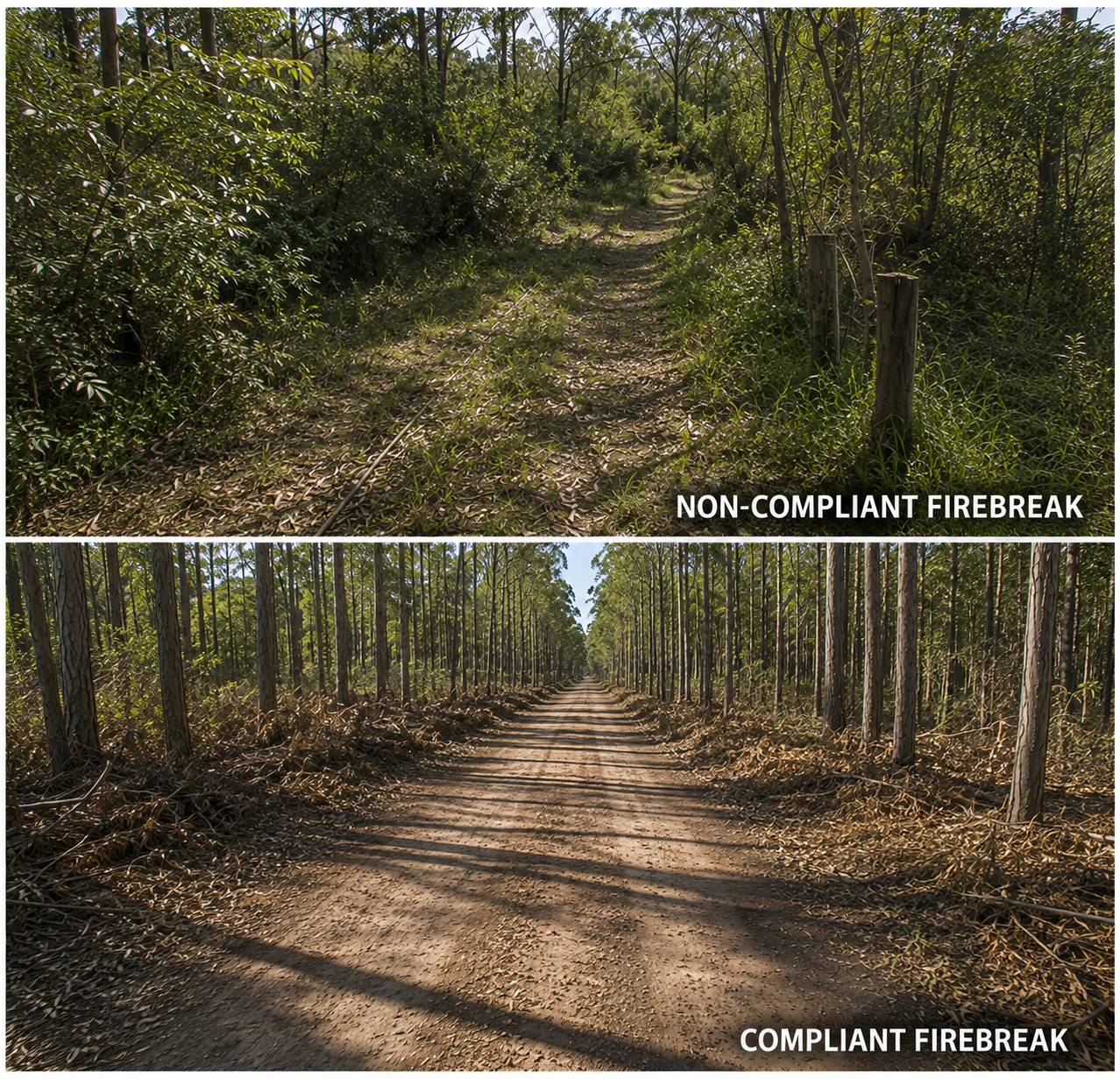
Within the Shire of Nannup (the Shire), firebreaks must be four (4) metres wide, with three (3) metres being mineral earth and have all trees and vegetation on both sides of the firebreak laterally pruned to a height of four (4) metres. The firebreak must be constructed within twelve (12) metres of the boundary of the property, with a width of six (6) metres at corners.
Dead-end firebreaks should be avoided wherever practicable. Where a dead-end firebreak is unavoidable, it should be clearly signposted with the distance to the end and include a turnaround suitable for a fire truck, with a minimum twelve (12) metre radius.
Driveways should always be maintained to the standard of your firebreak. If a fire truck cannot get into your property safely and turn around, it will not be able to defend your home from a bushfire.
Compliance Inspections
From 3 November, the Shire Ranger may inspect properties throughout the district to assess compliance with the Notice.
Inspections help identify fire risks early and support community preparedness before the peak bushfire season.
Where a property does not meet the requirements of the Notice, the Shire may take enforcement action under the Bush Fires Act 1954.
Depending on the circumstances, enforcement may include:
- Issuing a Work Order requiring the property to be brought into compliance within a specified timeframe.
- Issuing an infringement for failing to comply.
- The Shire may arrange for the required works to be completed by a contractor, with all associated costs recovered from the property owner.
The Shire's preference is always to achieve voluntary compliance. Property owners experiencing genuine difficulties meeting the requirements are encouraged to contact the Shire Ranger as early as possible to discuss their circumstances.
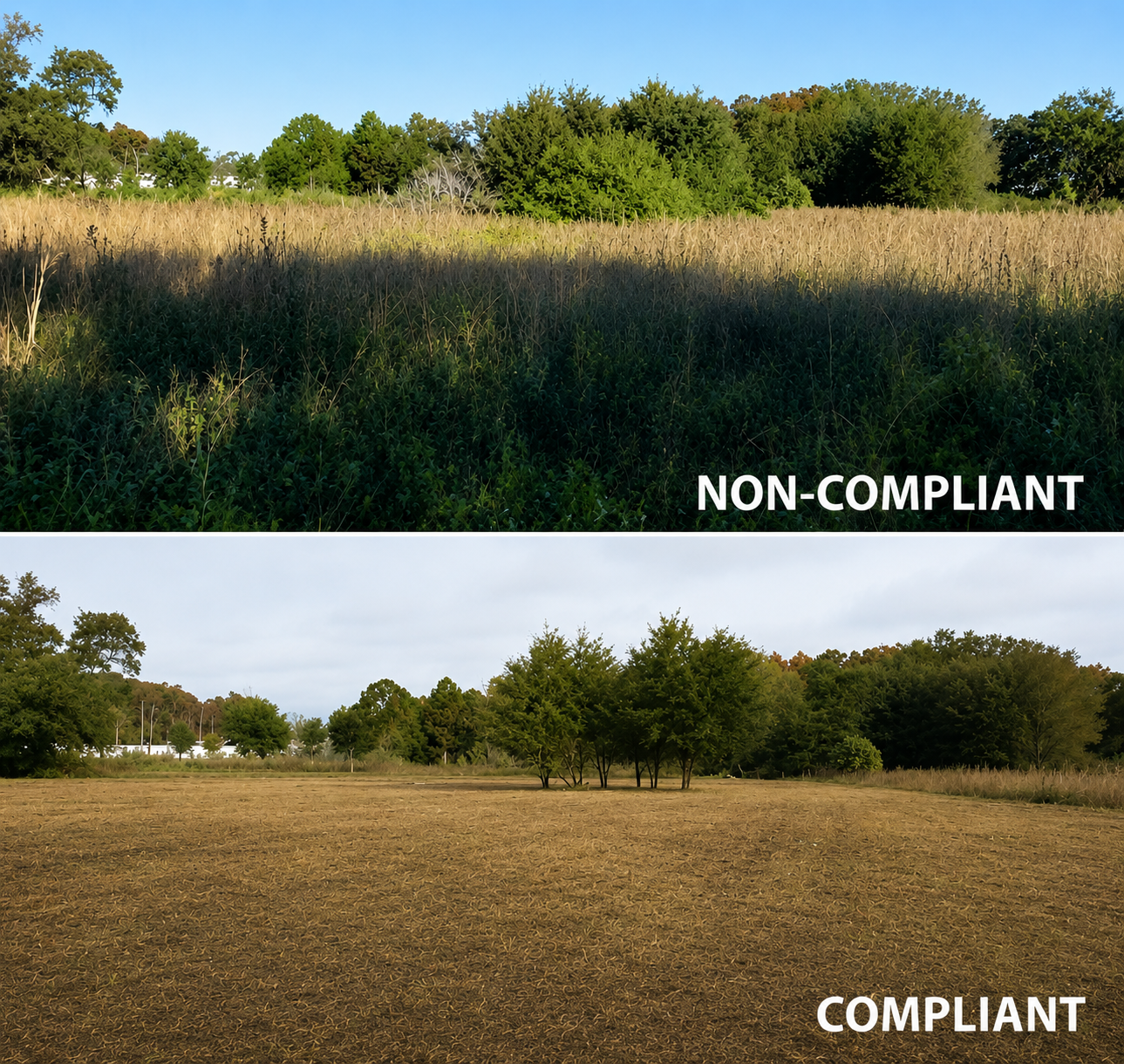
Examples below of compliant and non-compliant fire prevention works.
Owner/Occupier Responsibilities
If you own or occupy land within the Shire, you are responsible for:
- Reading the Notice and understanding your compliance obligations.
- Determining the zoning requirements that apply to your property.
- Completing all required bushfire prevention works before the compliance period commencing 3 November.
- Maintaining compliance until 30 April, or as otherwise specified in the Notice.
- Ensuring contractors or property managers acting on your behalf also meet these requirements.
Compliance must be maintained for the full compliance period, not just achieved once.
If you have any difficulties, please contact the Shire Ranger for clarification.
Identifying Your Property Zoning Requirements
Bushfire prevention work requirements vary depending on your property’s zoning, land use and site conditions. Before commencing works, refer to the steps below.
Step 1 - Check your property zoning
Refer to the Interactive Property Map to identify your property zoning.
Step 2 - Check the requirements for that zone
Refer to the current Bushfire Risk Compliance Notice to confirm the requirements that apply to your property.
For All Land
Asset Protection Zone (APZ) means a low fuel load area immediately surrounding a building and related structure to minimise the likelihood of flame contact with the building. APZs predominantly consist of managed vegetation, reticulated lawns and gardens and other non-flammable features.
- Maintain a twenty (20) metre low-fuel zone around each habitable building.
- Keep grass and flammable material below seventy-five (75) millimeters.
- Prune trees to a minimum height of two (2) metres above ground level.
- Keep tree branches at least three (3) metres clear of buildings
- Remove leaves, twigs and other flammable material from roofs, gutters and around buildings.
- Store wood piles and combustible materials well away from buildings.
The APZ requirements apply to all properties regardless of size and must be maintained all year round.
Urban Land
(Residential, Special Use and Nannup Townsite)
Lots 2,024m² or smaller
- Keep the property generally clear of flammable material.
- Maintain grass and vegetation below seventy-five (75) millimetres, except for living trees and garden plants.
Lots larger than 2,024m²
- Install firebreaks within twelve (12) metres of property boundaries.
- Firebreaks to be four (4) metres wide with at least three (3) metres mineral earth.
- Corner firebreaks to be six (6) metres wide.
- Prune vegetation alongside firebreaks to four (4) metres height clearance.
Rural Land
(Rural, Priority Agricultural, Environmental Conservation, Rural Smallholdings, Tourism, Urban Development, and other freehold land outside the Nannup townsite).
Rural Managed Land
- Maintain reduced fuel loads through grazing, slashing, baling or other active land management.
- A fuel reduction plan may be used.
- Perimeter firebreaks are encouraged but not mandatory.
Rural Unmanaged Land
Access to Buildings
All rural buildings must have vehicle access at least four (4) metres wide, with three (3) metres trafficable width and four (4) metres vertical clearance for emergency vehicles.
Rural Residential Land
- Firebreaks required within twelve (12) metres of all boundaries.
- Firebreaks must be four (4) metres wide with a minimum three (3) metres mineral earth surface.
- Corner firebreaks must be six (6) metres wide.
- Vegetation alongside firebreaks must be pruned to four (4) metres height clearance.
- Grass must not exceed seventy-five (75) millimetres in height.
- Firebreaks may not be required where the land is fully developed, maintained, mown, slashed or effectively irrigated.
Special Requirements
Special requirements apply in addition to the standard bushfire compliance requirements for property zoning.
- Hazards: Fire Control Officers may require additional works to remove or reduce specific bushfire hazards on a property.
- Bushfire Management Plans (BMPs) & BAL Assessments: Properties subject to an approved Bushfire Management Plan, Bushfire Attack Level assessment, or development approval conditions must comply with those requirements in addition to this Notice. Where requirements conflict, a variation should be sought from the Shire.
- Short-Stay Accommodation: Accommodation such as holiday homes, chalets, guesthouses, caravan parks, campgrounds and resorts may require a Bushfire Management Plan due to the increased risk to visitors unfamiliar with local emergency procedures.
- Plantations: Plantations larger than 3 hectares generally require Development Approval and must implement fire protection measures, including a Fire Management Plan where required. Plantation owners must meet specific firebreak, fuel management and residue disposal requirements during the declared compliance period.
- Minimum Standards: The Notice sets the minimum level of bushfire protection required to help safeguard individual properties and the wider community.
Important Dates
| Activity |
Date |
|
Firebreak compliance required by
|
3 November
|
|
Compliance must be maintained until
|
30 April
|
|
Shire property inspections commence
|
From 3 November
|
Property owners and occupiers are encouraged to complete required works well before the deadline to allow for contractor availability, weather conditions and unexpected delays.
Variation Applications
If you cannot meet the standard requirements of the Notice due to site constraints, access limitations, natural features or other relevant circumstances, you may apply for a variation.
An approved variation may allow bushfire prevention works to be completed in alternative locations or by another approved method that appropriately manages the bushfire risk.
How to apply for a variation
- Complete the Bushfire Risk Compliance Notice Variation Application. The application must be submitted by the property owner, or a person authorised to act on the owner's behalf. A separate application is required for each property.
- Obtain comments from your local Bush Fire Brigade (BFB) Fire Control Officer (FCO)
Provide your completed application to the Fire Control Officer (FCO) for your local Bush Fire Brigade (BFB) for comment and sign-off. The FCO provides a recommendation from the brigade’s operational perspective only and does not approve or refuse the application. They may recommend alterations to the proposed variation.
- Submit your application to the Shire by 31 October
Submit the completed application, including the FCO's comments, to the Shire before 31 October. Applications received after this date may not allow sufficient time for assessment and completion of the required works before the compliance period begins.
- The Shire assesses the variation application
The Shire will assess the proposed variation application having regard to the property, bushfire risk, access and operational considerations. The Shire Ranger may grant, refuse, alter or impose conditions as part of an approval. For complex variation requests, the Shire Ranger may require the application to be supported or completed by a suitably qualified bushfire planning consultant.
- If approved, implement your variation by 3 November
If your variation application is approved, all works specified in the approved variation must be completed by 3 November.
Approved variations and associated bushfire prevention works must be maintained for the full compliance period ending 30 April.
Important: Submitting a variation application does not remove your obligation to comply with the Bushfire Risk Compliance Notice. Unless and until a variation is approved, the standard requirements continue to apply.
A list of Fire Control Officers and their contact details can be found under Fire Control Officers available on the Shire website.
Hazard Reduction Contractors
You may engage a contractor to complete the required works on your behalf. Responsibility for compliance remains with the property owner or occupier.
A list of local Firebreak and Fuel Hazard Reduction Contractors is available from the Shire’s website.
Fire and Emergency
Please visit the Shire Fire and Emergency page for more information on Burning Periods, Fire Danger Ratings, Permits to Burn, Total Fire Bans, Bushfire Mitigation and Harvest and Vehicle Movement Bans.
Related legislation and Information
Contact Ranger Services
If you are unsure about your property's requirements, need help understanding the Notice, or have any questions about compliance requirements, please contact the Shire Ranger, who can assist you in understanding your obligations and prepare your property for bushfire season.
Phone: (08) 9756 1018
Email: nannup@nannup.wa.gov.au